AxioMed Data published in JBJS: Why Viscoelastic Discs Avoid Ball-and-Socket Wear Failures
PR Newswire
FORT LAUDERDALE, Fla., Jan. 26, 2026
Peer-reviewed evidence published in The Journal of Bone and Joint Surgery® (JBJS) strengthens the scientific foundation for AxioMed's viscoelastic disc as a next-generation approach in spinal arthroplasty
AxioMed , a KIC Ventures portfolio company, today announced the publication of a landmark peer-reviewed study in The Journal of Bone and Joint Surgery (JBJS) . The research provides a long-awaited scientific explanation for why the AxioMed viscoelastic lumbar disc replacement outperforms traditional ball-and-socket designs in both durability and biological safety.
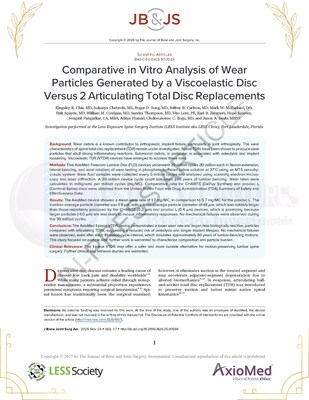
The study, " Comparative in Vitro Analysis of Wear Particles Generated by a Viscoelastic Disc Versus 2 Articulating Total Disc Replacements ," appears in the January 2026 issue of JBJS, the premier global journal for orthopedic musculoskeletal science.
FORT LAUDERDALE, Fla., Jan. 26, 2026 /PRNewswire/ -- Solving the "Wear Crisis" in Spine Surgery
For two decades, the promise of motion preservation was hindered by the market withdrawal of several high-profile ball-and-socket discs (including CHARITÉ®, prodisc® M6® , and others). These failures were often linked to wear-related osteolysis —bone loss caused by the body's reaction to microscopic debris.
This JBJS study identifies the critical mechanical and biological reasons behind these failures:
- Articulating Discs : Produce tiny, submicron particles (0.2 μm to 0.4 μm) that trigger an aggressive inflammatory response, leading to implant loosening.
- AxioMed Viscoelastic Disc : Produces significantly fewer particles that are biologically "quiet. " With an average diameter of 1.9 μm , these particles are too large to induce the inflammatory reactions that cause bone loss.
The Science of Longevity: 240 Years of Motion
Using advanced MTS servohydraulic testing, the AxioMed Freedom Lumbar Disc (FLD) underwent 30 million cycles—simulating roughly 240 years of human life—without a single mechanical failure.
Key Findings:
- 70% Lower Wear Rate : AxioMed showed a mean wear rate of just 1.7 mg/MC, compared to 5.7 mg/MC for the prodisc L.
- Structural Integrity : The one-piece viscoelastic polymer core maintained its performance through lateral bending, flexion-extension, and axial rotation.
- Biocompatibility : The study confirms that by mimicking natural disc physiology rather than mechanical joints, AxioMed reduces the risk of the body "rejecting" the implant through inflammatory debris.
Perspectives from the Lead Authors
" The goal was never to build a better joint—it was to recreate disc physiology," said Professor Kingsley R. Chin, MD, MBA , lead author and CEO of KIC Ventures . "This publication validates that a viscoelastic disc can reduce wear while producing particles that are less reactive, explaining why our technology has endured clinically for over a decade while articulating discs have struggled ."
Dr. Erik Spayde, MD , Chief Medical Officer of AxioMed and Harvard-trained surgeon, added: "Having worked with every major disc technology over 20 years, I saw the limitations of ball-and-socket designs firsthand. AxioMed behaves fundamentally differently—it absorbs load and distributes forces like a native disc. It is the future of motion preservation."
A Market Ready for a Proven Solution
The timing of this data coincides with a major shift in the spine care landscape:
- Payer Coverage : Major U.S. insurance carriers are now broadly covering lumbar disc replacement.
- High-Profile Success : Athlete success stories, such as Tiger Woods' transition to motion-preserving strategies, have increased patient demand for alternatives to spinal fusion.
- Proven Record : AxioMed boasts over 10 years of clinical follow-up with nearly 1,000 implants globally and zero reported device failures or explantations.
About the Research
The JBJS study confirms that AxioMed's viscoelastic design generates 70% less wear and significantly larger, biologically favorable particles than articulating competitors. By exceeding the 1.0 μm threshold for biological safety, AxioMed offers a more durable and safer alternative for patients seeking long-term motion preservation.
Read the full study on PubMed
https://pubmed.ncbi.nlm.nih.gov/41284766/
Disclaimer
This press release is for educational and informational purposes only and does not constitute financial, investment, or tax advice. All financial examples are illustrative and hypothetical based on commonly used assumptions. Results will vary. Individuals should always consult with a licensed financial advisor before making any investment or retirement planning decisions.
About KIC Ventures
Founded in 2013, KIC Ventures is a physician-founded and physician-led healthtech private equity firm and the creator of the LESS Exposure Spine Surgery (LESS™) treatment philosophy and technologies. Its portfolio includes MedTech spine-focused companies such as NANISX, AxioMed , and NanoFuse Biologics, and technology-driven ventures including Mediconnects and AxioMedX Smart Disc Technologies .
KIC Ventures partners with physicians to design and invest in innovative solutions that empower IPM physicians, orthopedic spine surgeons, and neurosurgeons with advanced, anatomy-preserving technologies.
We invent, innovate, and improve.
 View original content to download multimedia:https://www.prnewswire.com/news-releases/axiomed-data-published-in-jbjs-why-viscoelastic-discs-avoid-ball-and-socket-wear-failures-302670233.html
SOURCE KIC Ventures

